


Recommended for you


When sustainability opens up new markets
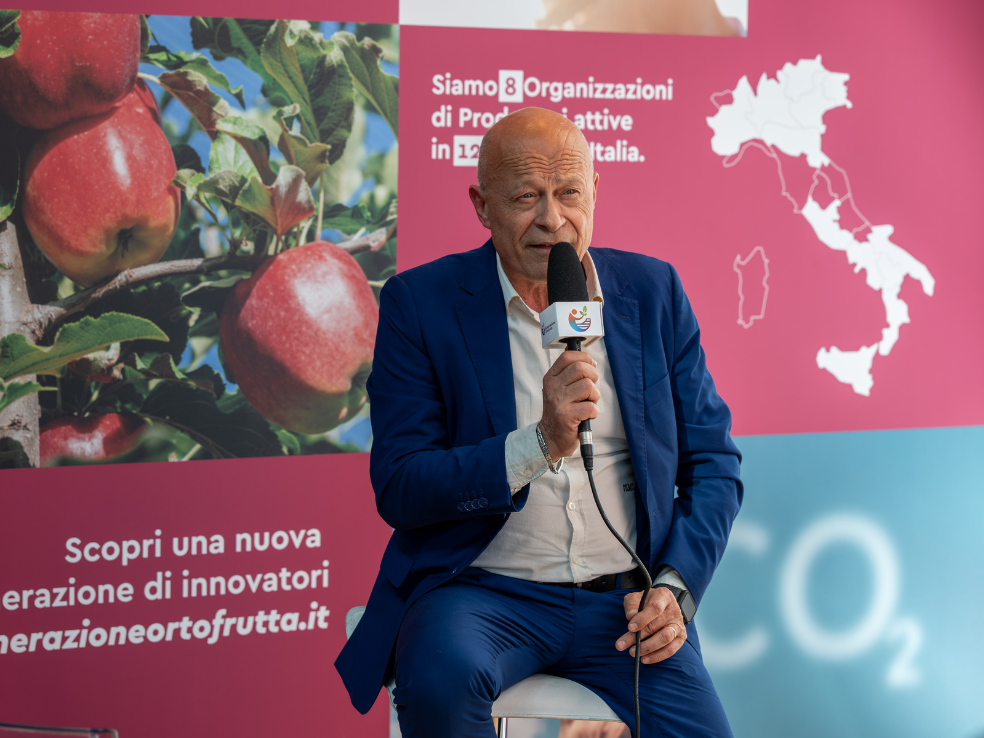
Massimo Baldan, president of Zeoli Fruit, explains how a clearer communication of sustainability can become a prime opportunity for the future of Italian fresh produce.
In the heart of the Agro Pontino, one of Italy’s most suitable regions for fruit growing, kiwifruit is a core part of local agricultural identity, the result of a tradition built over time by generations of growers. It is here that Zeoli Fruit operates, a Producer Organisation (PO) based in Cisterna di Latina.
At its helm is Massimo Baldan, president of the PO, who approaches sustainability from a highly pragmatic perspective: that of someone who must face climate change, resource management, and market competitiveness every day. For Baldan, sustainability cannot be treated merely as an environmental goal. It must also become a tool capable of creating value for businesses and generating new commercial opportunities for the sector.
Teaming up to tackle new challenges
The history of Zeoli Fruit is built on a simple principle: teamwork.
“In the heart of the Agro Pontino, we are a cooperative bringing together over 110 growers across a total area of around 600 hectares,” explains Baldan. “The core business of our cooperative is kiwifruit, across all its flesh colours, ranging from green to yellow and red.”
Over the years, the PO has supported the sector’s evolution by complementing traditional green kiwifruit production with new yellow- and red-fleshed varieties, which are increasingly demanded by the market. This growth has required investments, innovation, and an ever-increasing capacity to adapt to change.
Resources to protect
When discussing sustainability, Baldan identifies three distinct priorities: people, energy, and water.
“The three most crucial areas are protecting the people who work in our supply network, saving energy, and conserving water resources, which are essential for our crops.”
These aspects are closely interconnected. On one side, there is the need to ensure proper working conditions throughout the supply chain. On the other, the growing pressure exerted by climate change necessitates increasingly efficient natural resource management. Recent investments made by Zeoli Fruit fall precisely into this direction.
“The change we introduced in recent months was expanding our cold storage with controlled atmosphere rooms, which reduce energy consumption and consequently eliminate waste.”
A common language to communicate sustainability
For Baldan, however, practicing sustainability is not enough. It is also necessary to find an effective way to communicate it. This is one of the main reasons that led Zeoli Fruit to join the Generazione Ortofrutta project.
“It is a very compelling project. There are 28 POs involved, representing around 4,000 agricultural holdings across more than 33,000 hectares.”
Beyond the figures, what he considers truly strategic is the introduction of a shared Standard capable of making corporate commitments clearer and more comparable.
“The most important aspect is the introduction of a single protocol, a unified Standard, because it is essential to have a common language for both domestic and, above all, international markets.”
In an environment where consumers, distributors, and buyers increasingly demand detailed information on production processes, being able to rely on shared and verifiable parameters becomes a decisive factor. According to Baldan, a common standard can help turn sustainability from an abstract concept into a recognizable value.
From climate change to future opportunities
The aspect Baldan considers most relevant, however, concerns the long-term outlook. Making business efforts measurable and communicable creates new market opportunities.
“The key transformation we must consider is using a certification tailored for export markets, one that is commercially viable and serves as a true mark of quality.”
Sustainability is thus viewed not as an added cost, but as an element capable of strengthening the market positioning of Italian produce and unlocking new commercial outlets.
This conviction stems from observing the transformations shaping the fresh produce sector. For Baldan, the need to innovate and highlight the work of businesses is closely linked to the daily challenges facing the industry, starting with the increasingly evident impacts of climate change.
It is precisely by observing these phenomena that he identifies his personal “GO”.
“My ‘GO’ moment was witnessing the effects of climate change on our produce. The interest stems directly from that: trying to provide a real answer to the thousands of families currently facing difficulties.”
An answer that, for Baldan, can only be delivered through collective effort.
“That is why we are here: to unite, bring a shared voice, and find tangible solutions for our members.”


