


Recommended for you


A common grammar to speak about sustainability
How the language of Italian fresh produce is changing, with Sarah Bua.
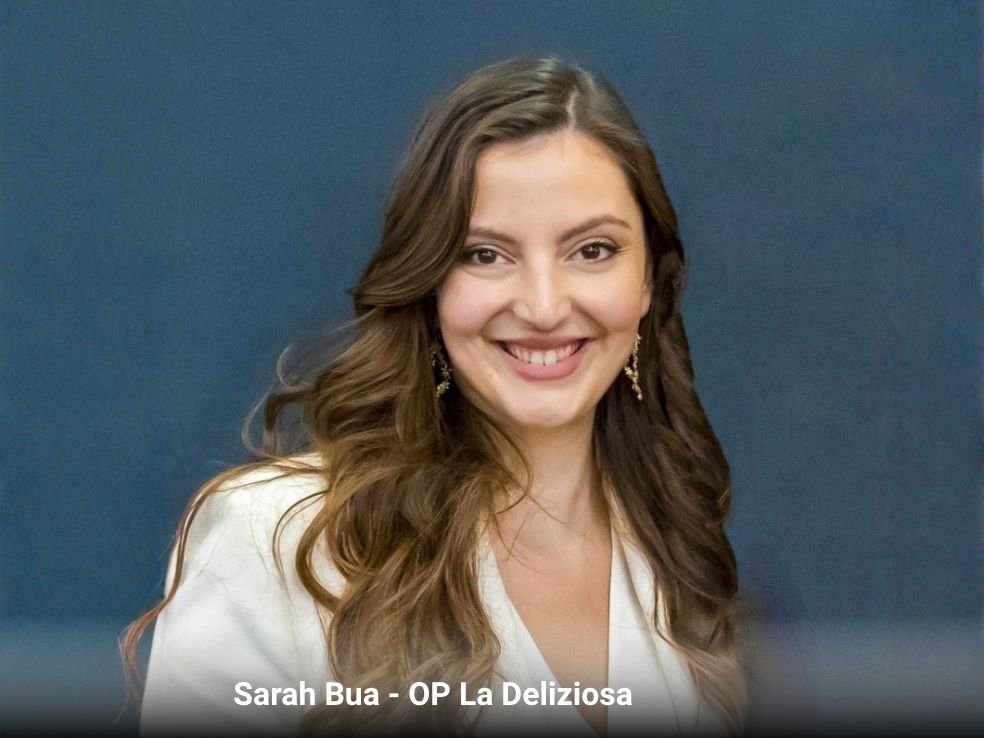
One of the objectives of the Generazione Ortofrutta project is to tell the story of sector sustainability through the voices of those who experience it every day. Today, discussing sustainability is no longer merely a choice, but a shared responsibility that also relies on communication capable of making processes understandable and providing context for products, helping consumers understand what lies behind them and why it matters. It is precisely within this space that the commitment of Sarah Bua fits: the voice of a new generation striving to redefine how fresh produce is communicated.
Born in 1999, Sarah is Head of Communications at OP La Deliziosa, a Producer Organisation based in Biancavilla (Catania) that aggregates some of Sicily’s finest agricultural products, from Fico d’India dell’Etna DOP (DOP Etna Prickly Pear) and Pesca di Leonforte IGP (IGP Leonforte Peaches) to Pachino tomatoes. Her words reflect the clarity and determination with which she views the Italian fresh produce sector, alongside an urgent need to transform how it is portrayed.
Communicating fresh produce amid challenges and opportunities
According to Sarah, the narrative surrounding the fresh produce sector remains trapped in a stereotypical image, unable to convey the real value created across the entire supply chain. Discussions continue to focus heavily on product, territory, and tradition, while everything concerning processes, strategic decisions, and impacts remains secondary in the eyes of the consumer. It is precisely within this gap between reality and storytelling that her career path took shape. Before entering the fresh produce domain, Sarah trained elsewhere, developing a perspective that now allows her to interpret the sector with greater awareness.
“Despite being fortunate enough to grow up in an environment where love and respect for the land are part of daily life, I never felt obligated to work in the family business. At university, I studied modern languages and cultural mediation, lending a hand during trade fairs and international events. It was there that I realised what I enjoyed doing could also be applied to fresh produce. Today, I give a voice to the team at OP La Deliziosa, a young and dynamic team working diligently at every step of the supply chain, representing the true strength of our organisation. Effectively communicating all their hard work is a massive responsibility and a genuine challenge.”
Knowing how to translate and interpret reality becomes a key tool for promoting Sicilian agricultural excellence, starting with the Fico d’India dell’Etna DOP, for which she currently serves as President of the Protection Consortium.
“We are still a young Consortium in an adjustment phase, but for that very reason, we are full of potential. Despite being a fruit deeply tied to Sicilian identity, the prickly pear was long relegated to the margins of the narrative, perceived as overly traditional, almost wild. In reality, it is a product with far greater value than people imagine: a symbol of a truly sustainable way of farming.”
The prickly pear’s ability to adapt to arid and rocky soils, absorb large quantities of CO₂, operate with low water requirements, and allow every part of the plant to be repurposed makes it a practical example of applied sustainability,a conscious production model that unites environmental stewardship, territorial enhancement, and value creation across the supply chain.
The role of communication: searching for a common language
For the transition toward more sustainable production models to take firm root, communication plays a decisive role. As Sarah emphasizes, the value of Italian fresh produce is immense, yet it often struggles to find adequate means to tell its story. Tight profit margins and limited investment capacity make building long-term strategies difficult. Added to this is a complex system of overlapping regulations, certifications, and compliance metrics that frequently generate confusion.
In recent years, social media has opened up new possibilities, enabling direct communication and revealing aspects that were previously invisible. For Sarah, however, this is not enough. The real challenge lies in constructing a shared language capable of linking what happens in the fields, in the packhouse, and along the supply chain, a language that brings consistency to a narrative that remains highly fragmented.
The new grammar of sustainability
Sarah offers the perspective of a new generation that does not merely report on change, but feels responsible for making it legible and shared, shifting focus from individual products to production processes, operational choices, and generated impacts. Consumer demand is becoming increasingly discerning and informed:
“When discussing sustainability, one must always be extremely careful to avoid the risk of greenwashing. That is why it is necessary to build a solid foundation that generates long-term value, backed by scientific data, clear measurement criteria, and verifiable systems that apply to everyone.”
In this sense, speaking of a “common grammar” means giving concrete shape to change through shared criteria, definitions, and parameters; it means establishing a unified language to discuss agricultural practices, emissions, and fair working conditions.
This is precisely the trajectory pursued by the sustainability standard to be introduced by Generazione Ortofrutta, translating good agricultural practices into clear, measurable parameters supported by scientific evidence. These are not merely recommendations, but concrete, shared operational tools.
Making these elements legible is the essential first step toward restoring the Italian fresh produce sector to a central position, not just as a production system, but as an active driver of regional and community development.
Only then can sustainability cease to be an abstract principle and become a common language capable of generating value and shaping the future.


