


Recommended for you


Ozone: how can it make fresh produce more sustainable?
From irrigating water sanitisation to post-harvest fruit preservation, ozone is finding applications in an increasing number of agricultural enterprises. But what is its real potential? And what are its limitations?
Ozone represents an interesting tool for making certain fresh produce processes more efficient and sustainable, particularly when integrated into a broader management system backed by scientifically validated protocols. But let us start with the basics.
What is ozone?
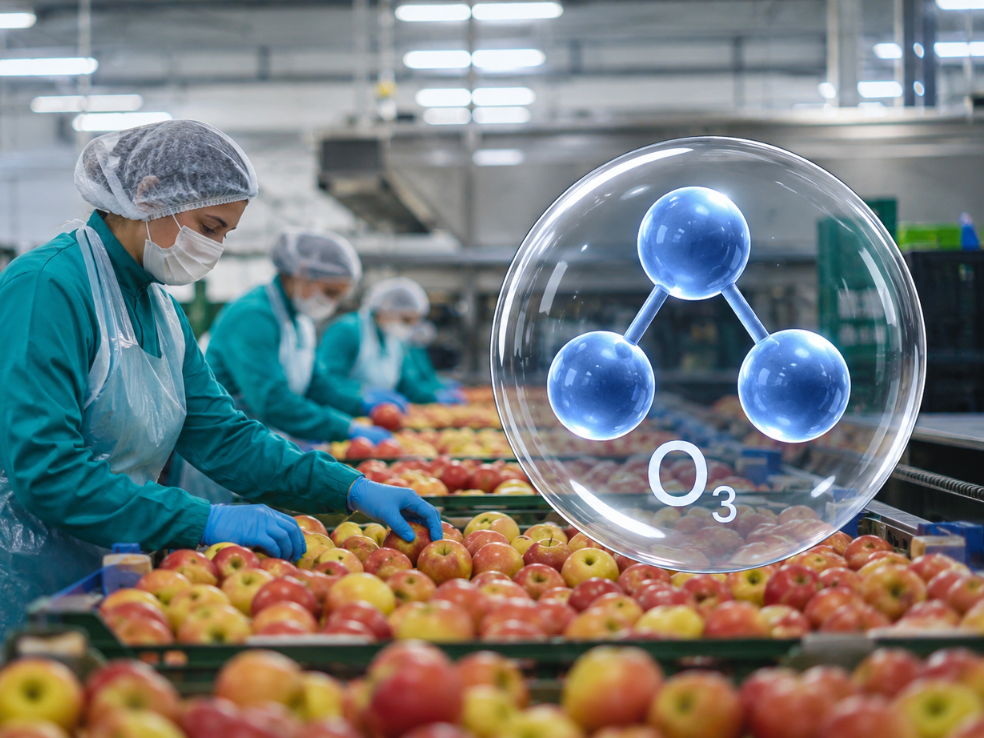
Ozone (O₃) is a molecule composed of three oxygen atoms. In nature, it occurs naturally in the atmosphere and protects the Earth from the sun’s ultraviolet rays. For agricultural use, it is produced artificially and used for its oxidizing properties, which allow it to deactivate bacteria, fungi, viruses, and other microorganisms potentially harmful to crops.
One of its most compelling features is that, after performing its function, it breaks down rapidly back into oxygen (O₂), leaving no persistent residues behind.
Ozone in the field: supporting sustainable crop management
In agriculture, ozone is predominantly used in the form of ozonated water: the gas is dissolved in water, which can then be used for cleaning irrigation systems, sanitising distribution lines, or applying other crop treatments. Its oxidising capacity improves the microbiological quality of the water and keeps distribution systems cleaner.
Its effectiveness depends on numerous factors, such as concentration, contact time, water quality, and the types of microorganisms present. For this reason, it is considered a complementary tool within integrated pest management strategies rather than a viable alternative for every situation.
Post-harvest: ozone gains ground in packhouses
It is during the post-harvest phase that ozone finds its most established applications today. In packhouses, it can be used both in gaseous form and in wash water to sanitise cold storage rooms, processing lines, crates, and surfaces that come into contact with fruit and vegetables. The goal is to reduce the presence of microorganisms that can compromise product preservation.
Several studies show that proper ozone use can help slow down certain deterioration processes and, under specific conditions, extend the commercial shelf life of various fresh produce species. This helps limit a portion of the losses occurring along the supply chain, yielding positive effects from both an economic and environmental standpoint.
However, the technology requires controlled application. Excessively high concentrations or inadequate exposure times can cause quality degradation in particularly sensitive species. Furthermore, ozone is a respiratory irritant, and its use must take place in environments designed according to specific safety criteria, complete with monitoring systems and dedicated procedures to protect operators.
A technology that gains value as part of a broader strategy
Rather than a universal solution, ozone today represents a process technology. Its contribution depends not only on its properties, but above all on how it is applied: concentration, contact times, water quality, crop type, and the specific stage of the supply chain are all factors that determine its efficacy.
Scientific research converges on this exact point: ozone can deliver concrete benefits in fresh produce sanitisation and preservation, but only when incorporated into validated protocols and an overall management strategy focused on efficiency and quality. Rather than replacing other practices, it helps make them more effective, demonstrating how agricultural innovation stems from the integration of scientific knowledge, technology, and good operational practices.
Sources:
- “Ozono in agricoltura: difesa, tolleranza agli stress e residuo 0.” AgroNotizie, 29 Apr. 2025, https://agronotizie.imagelinenetwork.com/difesa-e-diserbo/2025/04/29/ozono-in-agricoltura-difesa-tolleranza-agli-stress-e-residuo-0/87226.
- Botondi, Roberta, Monica Barone, and Claudia Grasso. “A Review into the Effectiveness of Ozone Technology for Improving the Safety and Preserving the Quality of Fresh-Cut Fruits and Vegetables.” Foods, vol. 10, no. 4, 2021, article 748. https://doi.org/10.3390/foods10040748.
- Hong, Hao, et al. “A Meta-Analysis on the Antimicrobial Effectiveness of Ozonated Water Treatments for Fresh Produce Washing—Effect of Ozonation Methods.” Foods, vol. 13, no. 23, 2024, article 3906. https://doi.org/10.3390/foods13233906.
- Xu, Jin-Peng, et al. “Effects of Ozone Water Irrigation and Spraying on Physiological Characteristics and Gene Expression of Tomato Seedlings.” Horticulture Research, vol. 8, 2021, article 180. https://doi.org/10.1038/s41438-021-00618-8.
- Liu, Chao, et al. “Effects of Aqueous Ozone Treatment on Microbial Growth, Quality, and Pesticide Residue of Fresh-Cut Cabbage.” Food Science & Nutrition, vol. 9, no. 1, 2021, pp. 52–61. https://doi.org/10.1002/fsn3.1870.


