


Recommended for you


“Organic farming? A long-term choice”
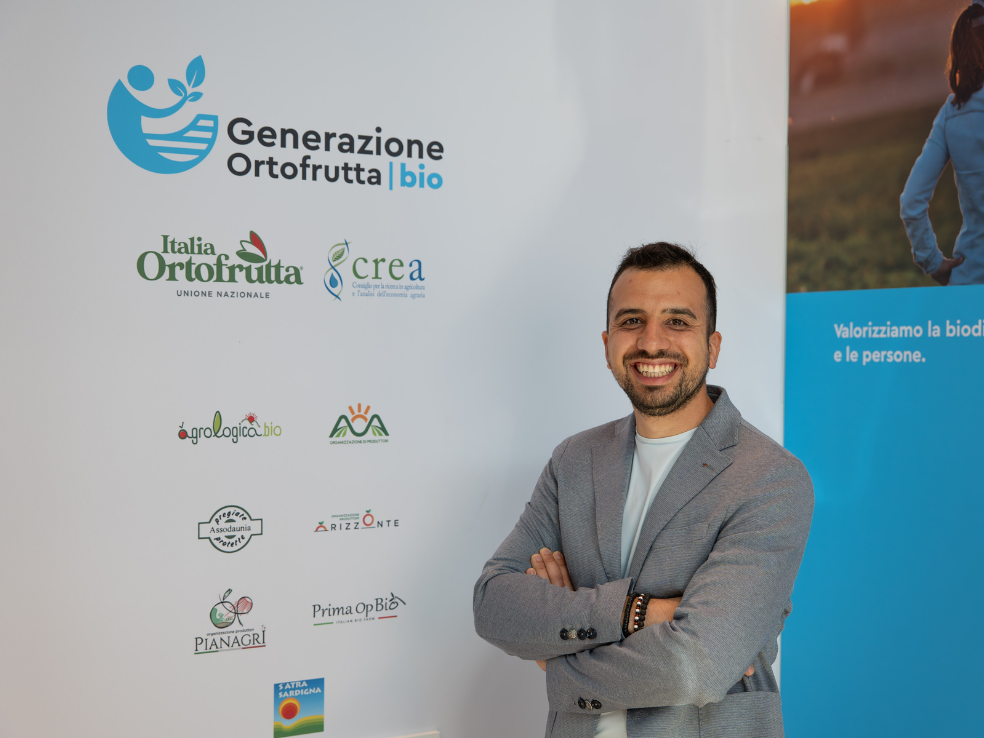
Gabriele D’Angelo, agronomist at OP Agrologica, explains how sustainability, experimentation, and soil care are transforming fresh produce cultivation in Sicily.
“My spark, my ‘GO’ moment, was when I came across a book titled Regenerative Agriculture.”
For Gabriele D’Angelo, agronomist at OP Agrologica, everything stems from that point: a curiosity for an agricultural model capable not only of producing, but also of restoring value to the soil and the environment. This awareness developed while studying sustainable practices and observing firsthand how climate change is already reshaping agricultural work. “Agriculture is the very first sector to feel the impact,” he explains.
D’Angelo works within OP Agrologica, providing technical assistance and managing sustainability-focused experimentation. Established in 1996 in the heart of south-eastern Sicily, between the Hyblaean Mountains and the coastal belt of Ragusa and Syracuse, the Producer Organisation today unites 32 contributing members specializing in organic production.
Between soil and innovation
At OP Agrologica, sustainability is not presented as an abstract goal, but as a series of concrete choices spanning every stage of production. For D’Angelo, three central themes stand out: reducing agricultural waste, limiting synthetic inputs within the crop production cycle, and increasing the soil’s carbon sequestration capacity.
“We are attempting to implement no-till or minimum tillage farming to enhance carbon storage within the soil.”
This trajectory embraces regenerative agriculture and the long-term capacity of agricultural soils to preserve fertility, structure, and biodiversity.
Alongside agronomic practices, the PO has also invested in renewable energy and sustainable materials. Photovoltaic installations have been fitted across packhouse facilities, beneficial insects are deployed in the field as part of integrated pest management, and trials are underway with compostable twine and biocompostable plastics to reduce the environmental footprint of cultivation.
A challenge embraced thirty years ago
For OP Agrologica, organic farming is neither a recent trend nor a decision driven by short-term market shifts. It is a journey that began nearly thirty years ago, when championing organic agriculture meant swimming against the tide and betting on a production model that was little understood at the time. Over time, this commitment has helped build a distinctive identity and a specialized supply chain capable of combining supply continuity, quality, and environmental stewardship.
Today, this experience translates into a highly specialized supply chain encompassing Mazzarrone table grapes (IGP), Pachino tomatoes, and various vegetable crop varieties grown between the Plain of Gela and Ragusa’s intensive greenhouse belt.
The connection to the land remains central to daily technical operations. The area’s loose, calcareous soils, combined with a favourable climate, enable high-quality production for much of the year, particularly in organic farming, where supply continuity requires meticulous agronomic and operational management.
Sustainability as a concrete responsibility
D’Angelo’s account reveals a highly practical vision of sustainability: not a buzzword used for market differentiation, but a responsibility demanding study, monitoring, and adaptability.
It is for this reason that OP Agrologica has chosen over the years to complement organic standards with additional environmental and social sustainability certifications, ranging from GlobalG.A.P. and GRASP to the INPS “Quality Agricultural Work” accreditation.
This approach bridges production, land stewardship, and fair labour conditions, grounded in the conviction that the future of fresh produce relies on building more resilient and conscious supply chains.
“Initially, it was mostly curiosity,” says D’Angelo, reflecting on his personal “GO”. “Then I realised that all these practices can provide tangible support to help the agricultural sector navigate climate change.”
It is precisely in this continuous search for balance between innovation, productivity, and respect for natural resources that Agrologica is actively building its vision for the future of fresh produce.


