


Recommended for you


“Being sustainable to be more competitive”
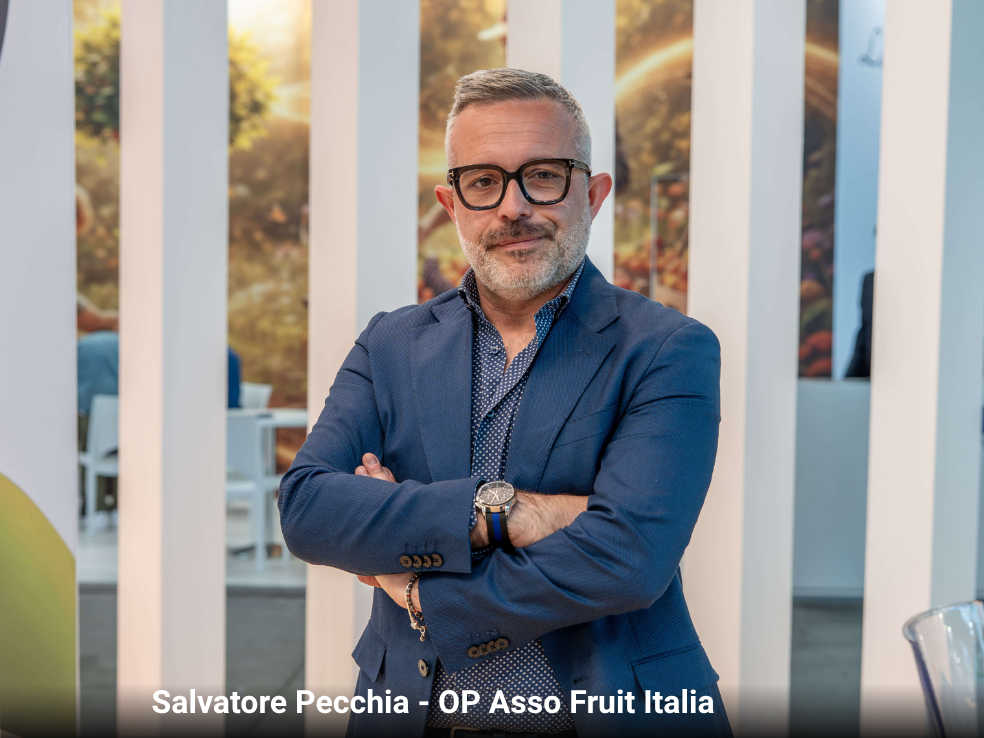
Salvatore Pecchia of OP Asso Fruit Italia explains why joining forces and adopting sustainable production methods are crucial for tackling market demands.
As a second-generation grower raised on his father’s farm, which he now runs, Salvatore Pecchia is one of the most respected managers in the fresh produce sector. Armed with solid agronomic expertise, he plays a strategic role in research and innovation at OP Asso Fruit Italia and AOP Arcadia. For Pecchia, sustainability is not an optional extra: it is a prerequisite for competing on international markets.
“I graduated in 2008 from the University of Basilicata, but even during my studies I engaged with a broader international context,” explains the 43-year-old from Scanzano Jonico, in the province of Matera. “During my final year in the Faculty of Agriculture, I took part in an Erasmus placement at the Technical University of Munich (TUM), working on a research project focused on extracting polyphenols from olive leaves.”
Following a research grant in applied phytopathology, his transition to the commercial sector came in 2010 when he joined Asso Fruit Italia. “I entered the world of Producer Organisations and began working on operational programmes. From there, I specialised in subsidized financing and the funding opportunities made available to agricultural holdings by the Region, the Ministry, and the European Union.” Since 2020, he has also served as coordinator of AOP Arcadia, an association aggregating three Producer Organisations. “I mainly oversee supply chains, research, and sustainability. It is a strategic service for our members, because certain opportunities can only be seized at an aggregated scale.”
Indeed, when asked about his personal “GO” moment, his moment of professional revelation, Pecchia has just one answer: aggregation. It is a concept that is not merely theoretical for him, but deeply personal. “My father owned a farm and never really believed in organised structures: he sold to whoever offered the highest price at that moment. That way of working, which functioned back then, is no longer viable today.
The market is globalised, and competition is fierce. Today, certain opportunities simply do not exist unless you are part of an organised system. Think of supply chain contracts: an individual holding cannot access them alone. The same applies to applied research and continuous professional development, not to mention the advocacy work carried out for the sector by organisations like Italia Ortofrutta.”
One of the most significant results of this collaborative approach arrived in 2025 with the IGP accreditation for Basilicata Strawberries (Fragola della Basilicata IGP). “It was a two-and-a-half-year journey following several unsuccessful attempts. On November 5th, we achieved our goal.” Pecchia serves as president of the promoting committee and coordinated the efforts of all involved parties. “It was a major victory for the entire system, not belonging to a single organisation, but to the whole sector. It proves that when we work together, we can achieve landmark results.”
Pecchia can be described as a tireless professional. His days start early and finish late. “I answer calls from seven in the morning until evening. Some tell me I overdo it, but it doesn’t weigh on me.” The explanation is simple. “I love what I do. And I consider myself fortunate to be able to do it in the region where I chose to live.” It is a region that, despite infrastructural challenges, is transforming rapidly. “Technology is advancing, research infrastructure is improving, and there is a renewed energy, particularly among younger people.”
“Over the last seven years,” he notes, “around 1,500 new agricultural holdings have been established in Basilicata, with a growing presence of young people and women.” Even among Asso Fruit’s members, many farm owners are under 40, while women head key departments, from technical and administrative offices to commercial operations. “They bring a precise, methodical approach that is invaluable in our work. They represent true added value.”
For Pecchia, the future direction of fresh produce is clear. “We are moving toward a more dynamic, conscious sector, one that is better equipped to interpret change and take a long-term view. Here in the Metapontino area, we are envisioning a different kind of agriculture, for example, exotic fruit like mangoes and avocados, which are currently active crops across a few hectares but hold vast market potential.”
Behind all of this lies a clear vision of the sector’s role. “We need to move past the image of the grower as a mere producer. Today, the grower is also a steward of the land, water, and air.” This responsibility translates into concrete actions where sustainability is no longer an optional goal. “It is the condition for remaining competitive. Sustainable production means respecting the environment, but also generating income and value. It is a complex balance, but an absolute necessity.”


